Protect Your Book. Protect Your Money.
What Every Author Should Know Before Hiring a Publishing or Book Marketing Company.
Writing a book can be personal. Hiring someone to publish or market it is a business transaction.
Authors can spend hundreds or thousands of dollars on editing, publishing packages, websites, advertising, publicity, social-media promotions, and book marketing. Some providers deliver valuable professional services. Others make impressive promises that are difficult to verify, charge large upfront fees, or sell services that produce little measurable value.
Before paying anyone, slow the process down long enough to verify who you are dealing with, exactly what you are buying, and how success will be measured.
Your manuscript, publishing rights, accounts, money, and reputation are worth protecting.
Publishing Your Book Is a Business Decision
1. Verify the Company Exists
2. Never Rely on Verbal Promises
3. Demand Specific Deliverables
4. Be Careful With Large Upfront Payments
5. Separate “Activity” From “Results”
6. Keep Control of Your Publishing Accounts
7. Protect Your Copyright and Publishing Rights
8. Verify Marketing Claims
9. Understand How Your Money Will Be Used
10. Know How You Can Get Out
RED FLAGS THAT DESERVE A CLOSER LOOK
BEFORE YOU PAY — ASK THESE QUESTIONS

10 WAYS TO REDUCE YOUR RISK
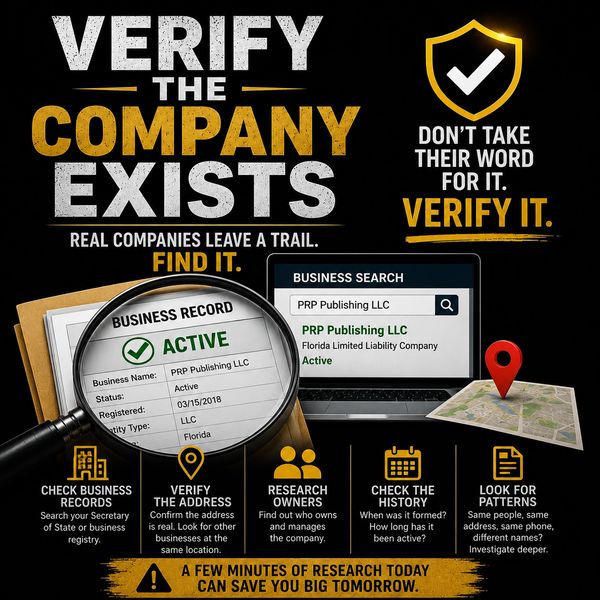
1. Verify the Company Exists
Do not rely solely on a professional-looking website.
Verify the company's legal business name, physical location, telephone number, corporate registration, and the identity of the person with whom you are doing business.
When appropriate, ask for documentation showing that the company is currently registered and in good standing.
A website is not proof that a business is legitimate.

2. Never Rely on Verbal Promises
If a salesperson promises:
“We can sell 2,000 books.”
“We'll make you a bestseller.”
“Your book will generate thousands in royalties.”
“We guarantee exposure.”
Ask for the promise to be placed in writing in the contract.
If a company will not put an important sales representation in writing, do not base your purchasing decision on it.
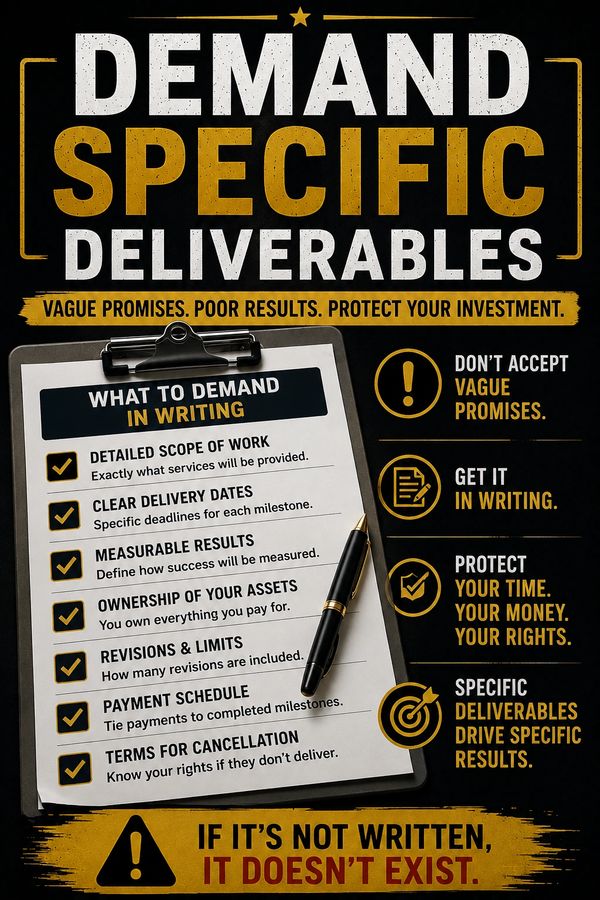
3. Demand Specific Deliverables
Avoid agreements containing vague descriptions such as:
- “Global exposure”
- “Premium promotion”
- “Extensive marketing”
- “Social-media campaign”
- “Amazon optimization”
- “SEO promotion”
- “Media exposure”
Instead, require specifics:
- What exactly will be done?
- How many advertisements?
- Which platforms?
- How long will the campaign run?
- How much advertising money is actually included?
- Who owns the advertising accounts?
- What reports will you receive?
- What happens if the work is not performed?
You should be able to determine whether every major contracted service was actually delivered.
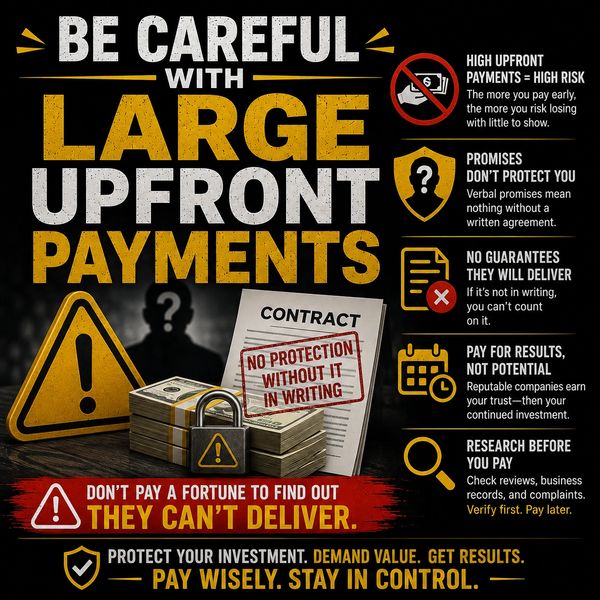
4. Be Careful With Large Upfront Payments
A large upfront payment transfers much of the financial risk to the author.
Consider negotiating milestone or performance-based payments when appropriate.
For example:
- Contract signed: Initial payment
- Publishing files completed: Next payment
- Marketing campaign launched: Next payment Defined deliverables completed: Final payment
The structure should fit the service being purchased. The important principle is simple:
Whenever possible, connect payments to clearly defined and verifiable work.
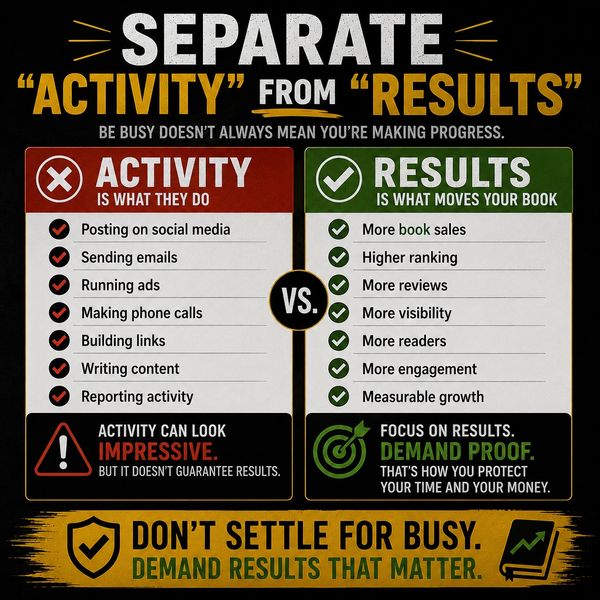
5. Separate “Activity” From “Results"
A marketing company can post on social media every day and still sell no books.
That doesn't necessarily mean the company did anything wrong but it demonstrates why authors should understand what they are purchasing.
There is an important difference between:
Deliverables: what the company promises to do and Results: what happens because of those activities.
A reputable contract should make that distinction clear.
Be particularly cautious when a company guarantees sales, bestseller status, media coverage, reviews, rankings, or specific financial returns unless the agreement clearly explains how that guarantee works and what happens if it is not achieved.
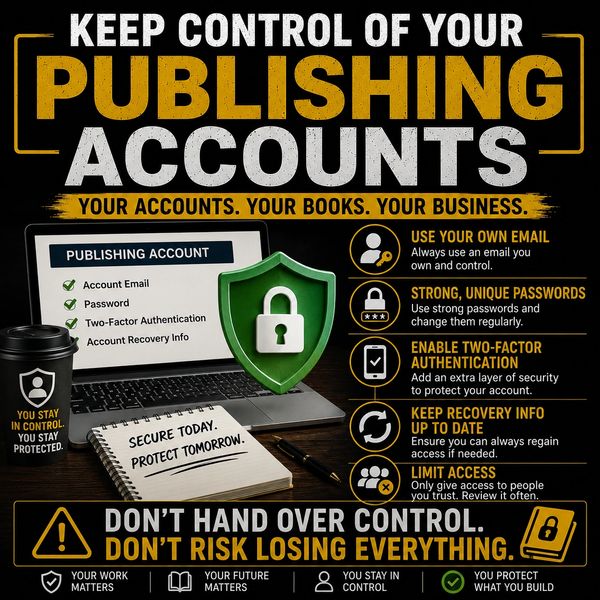
6. Keep Control of Your Publishing Accounts
Whenever practical, maintain ownership and administrative control of your:
- Amazon KDP account
- IngramSpark account
- ISBN records
- Domain name
- Website
- Email list
- Advertising accounts
- Social-media accounts
- Book files and cover files
A service provider may need authorized access to perform work.
That does not necessarily mean the provider should own the account.
Your publishing infrastructure can become one of your most valuable business assets.

7. Protect Your Copyright and Publishing Rights
Understand exactly what rights you are granting.
- Look carefully for provisions involving:
- Copyright ownership
- Exclusive publishing rights
- Distribution rights
- Translation rights
- Audiobook rights
- Film/television rights
- Licensing rights
- Derivative works
- AI training or content-use rights
- Length of the agreement
Paying a company to provide publishing services should not automatically require surrendering valuable intellectual-property rights.

8. Verify Marketing Claims
If a company claims impressive results, ask questions.
Which books have you marketed?
Can I see examples?
What exactly did your company do?
Can the results be independently verified?
Can I speak with previous clients?
Testimonials can be useful, but they should not replace independent due diligence.
Search the company name, principals, business records, complaints, litigation where relevant, and independent reviews before making a substantial payment.
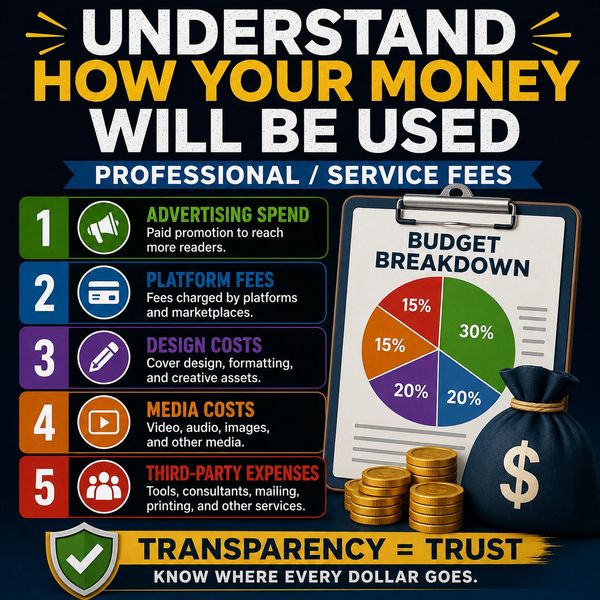
9. Understand How Your Money Will Be Used
If you are paying $3,000 for “book marketing,” determine how much of that money is actually going toward advertising.
A $3,000 marketing package and a $3,000 advertising budget are not the same thing.
Ask for a written breakdown identifying:
- Professional/service fees
- Advertising spend
- Platform fees
- Design costs
- Media costs
- Third-party expenses
If advertising is involved, determine who controls the advertising account and whether you will have access to campaign performance data.

10. Know How You Can Get Out
Read the termination and refund provisions before signing.
Determine:
- Can either party terminate?
- How much notice is required?
- What happens to money already paid?
- What happens to unfinished work?
- Who receives the source files?
- Who retains account access?
- What happens to advertising campaigns?
- Are there automatic renewals?
- Is arbitration required?
- Where must disputes be resolved?
It is much easier to negotiate these provisions before money changes hands.
RED FLAGS THAT DESERVE A CLOSER LOOK

Red Flags
One warning sign does not automatically mean a company is dishonest. Multiple warning signs, however, should cause an author to investigate further.
Be especially cautious when you encounter high-pressure sales tactics; demands for immediate payment; guaranteed bestseller claims; guaranteed sales without clear written terms; vague deliverables; refusal to provide a written contract before payment; constantly changing representatives; unverifiable addresses or company information; requests for passwords instead of controlled account access; requests to transfer ownership of publishing accounts; unclear advertising budgets; repeated upselling after the initial purchase; or reluctance to put verbal promises in writing.
A particularly important rule:
If the sales pitch sounds substantially better than the written contract, make your decision based on the contract.
BEFORE YOU PAY — ASK THESE QUESTIONS
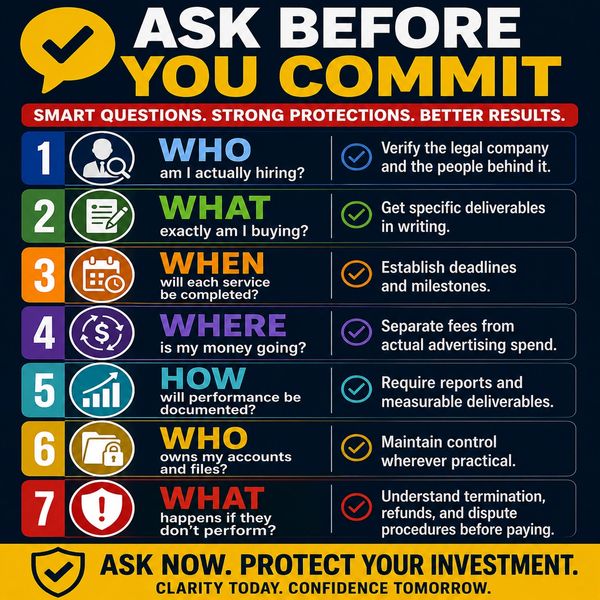
Ask Before You Commit
WHO am I actually hiring?
Verify the legal company and the people behind it.
WHAT exactly am I buying?
Get specific deliverables in writing.
WHEN will each service be completed?
Establish deadlines and milestones.
WHERE is my money going?
Separate fees from actual advertising spend.
HOW will performance be documented?
Require reports and measurable deliverables.
WHO owns my accounts and files?
Maintain control wherever practical.
WHAT happens if they don't perform?
Understand termination, refunds, and dispute procedures before paying.
How to Catch the Lie Before You Sign

Simple Ways to Verify What a Company Tells You
“Seven years in business?”
Check when the company's domain was registered. A recently created website doesn't automatically mean the company is new—but a major discrepancy deserves an explanation.
Check: WHOIS/domain registration records
“Established company headquarters?”
Search the complete address and suite number. See what other businesses use the same location and whether it is an actual office, shared workspace, or virtual address.
Check: Search engines, maps, business directories
“Our publishing division?”
Search state corporate records. Verify the legal business name, registration date, status, officers, and other companies connected to the same people.
Check: Secretary of State/business registry
“Hundreds of successful clients?”
Look beyond testimonials on the company's own website. Search for authors, books, clients, reviews, complaints, and independent evidence of the company's claimed track record.
Check: Search engines and independent review sources
Same address, different company names?
Search the company name, address, suite number, phone number, and key personnel separately. If multiple businesses keep appearing with the same contact information or people, investigate how they are connected.
Check: Search engines and public business records
Patterns Can Reveal Far More Than the Sales Pitch.
One inconsistency may have a legitimate explanation. Multiple inconsistencies involving a company's history, address, ownership, personnel, or claimed experience should be investigated before you sign a contract or send money.
An Informed Author Is a Better-Protected Author
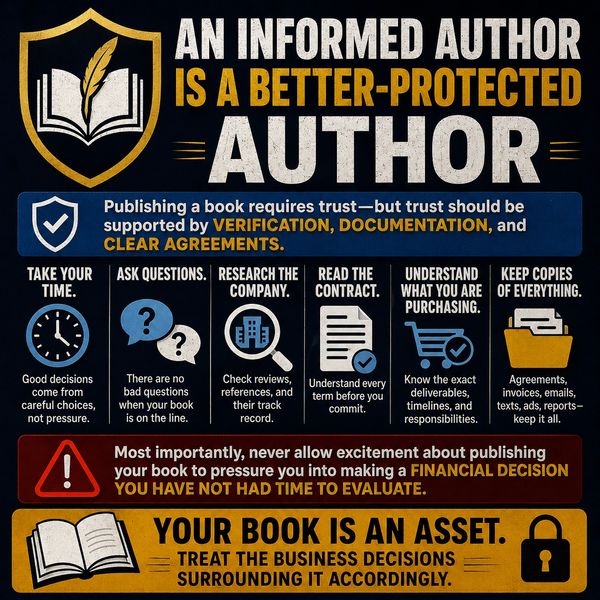
Establish Trust
Publishing a book requires trust—but trust should be supported by verification, documentation, and clear agreements.
Take your time. Ask questions. Research the company. Read the contract. Understand what you are purchasing. Keep copies of every agreement, invoice, email, text message, advertisement, sales representation, and performance report.
Most importantly, never allow excitement about publishing your book to pressure you into making a financial decision you have not had time to evaluate.
Your book is an asset. Treat the business decisions surrounding it accordingly.